11 Oct
Push-Up Progression Plan: From Knees to Full Push-Ups in 6 Weeks
If you can do knee push-ups but a full push-up still feels impossible, you’re closer than you think. A push-up progression plan builds the strength you need step by step — no gym, no equipment, just a smarter way to train. In six weeks of consistent practice, most healthy beginners can move from knee push-ups to clean, full push-ups.
This guide gives you a week-by-week plan, exact sets and reps, form cues, and the small adjustments that make the biggest difference. You’ll also learn the common mistakes that stall progress — and how to avoid them.
Why a Push-Up Progression Plan Works Better Than Random Attempts
Push-ups look simple, but a full push-up requires your chest, shoulders, triceps, and core to move roughly 60–65% of your body weight. That’s a lot of load for muscles that aren’t used to it.
A progression plan works because it applies progressive overload — gradually increasing the difficulty of each session so your muscles adapt. Knee push-ups, incline push-ups, and other scaled versions let you practice the movement pattern safely while your strength catches up. According to the CDC, adults should include muscle-strengthening activities on two or more days per week, and bodyweight exercises like push-ups count toward that target.
Skipping progressions and forcing out ugly, half-range push-ups is how plateaus (and shoulder pain) happen. The plan below fixes that.
How to Do a Push-Up Correctly (Master This First)
Before you start the plan, lock in your form with knee push-ups. Bad form at the easy levels becomes bad form at the hard ones.
The setup
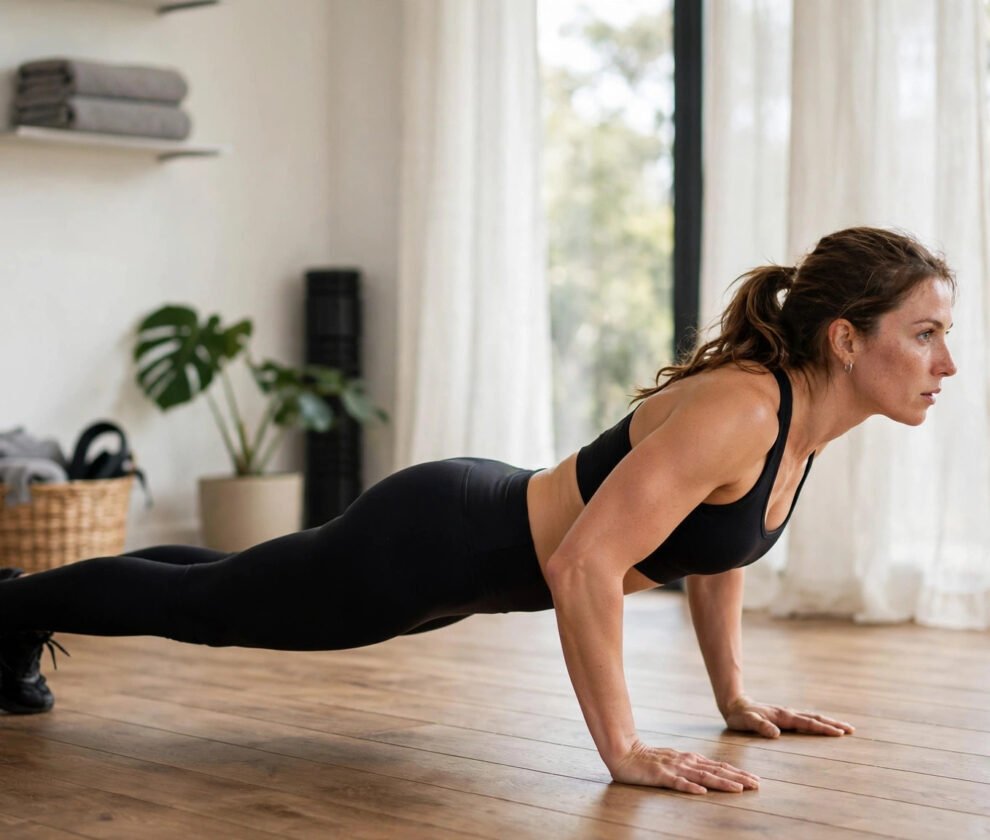
- Hands: Place them slightly wider than your shoulders, fingers pointing forward or slightly outward.
- Body line: From your knees to your head, keep one straight line. Squeeze your glutes and brace your core like someone might poke your stomach.
- Head position: Look at the floor a few inches in front of your hands — don’t crane your neck up.
- Elbows: Tuck them at roughly 45 degrees from your torso, not flared out at 90 degrees. This protects your shoulders.
The rep
- Lower yourself in a controlled 2–3 seconds until your chest is about a fist’s height from the floor.
- Push back up in about 1–2 seconds without letting your hips sag or pike up.
- Breathe in on the way down, breathe out as you push up.
If you can already do 10 clean knee push-ups with this form, you’re ready for the 6-week plan. If not, spend a week or two practicing knee push-ups first — there’s no rush.
The 6-Week Push-Up Progression Plan
How to train: Do the push-up workout 3 non-consecutive days per week (for example, Monday, Wednesday, Friday). Rest 60–90 seconds between sets. On off days, rest or do light activity like walking for general fitness. Each session takes about 10–15 minutes.
Important rule: Only move to the next week when you can complete the prescribed sets and reps with good form. If a week feels too hard, repeat it once — that’s normal progress, not failure.
Week 1–2: Solid Knee Push-Ups
- 3 sets of 8–10 knee push-ups, resting 60 seconds between sets
- Focus on perfect form: straight body line, controlled lowering, full push to the top
Move on when: you can do 3 sets of 10 with clean form.
Week 3: Elevate the Difficulty (Negative Push-Ups)
- 3 sets of 6–8 negative push-ups: start in a full plank position, lower yourself slowly for 3–4 seconds to the floor, then reset back to knee position to push up
- Negatives (the lowering phase) are where most strength is built — don’t rush them
Move on when: you can do 3 sets of 8 negatives with control.
Week 4: Incline Push-Ups
- 3 sets of 8–12 incline push-ups with hands on a sturdy chair, bench, or countertop
- The higher the surface, the easier it is — lower the surface as you get stronger
Move on when: you can do 3 sets of 12 on a low step or sturdy chair.
Week 5: First Full Push-Ups (Greasing the Groove)
- Do 3 sets of knee push-ups (10 reps), then finish each session with 2–3 sets of as-many-quality-reps-as-possible (AMRAP) full push-ups — even if that’s just 1–2 reps
- Stop each AMRAP set before your form breaks down
Move on when: you can do 5 consecutive full push-ups with good form.
Week 6: Build Your Full Push-Up Base
- 4 sets of 6–10 full push-ups, resting 60–90 seconds between sets
- Total target: 25+ quality reps across the session
By the end of week 6, most people can do 10+ consecutive full push-ups — a genuine milestone. If you’re new to strength training at home without equipment, this is an excellent foundation to build on.
5 Form Mistakes That Stall Push-Up Progress
1. Flaring your elbows wide
Elbows at 90 degrees from your body put extra stress on the shoulders. Keep them tucked at about 45 degrees.
2. Letting your hips sag
A sagging lower back means your core checked out. Squeeze your glutes and brace your abs throughout every rep. If your hips drop, end the set — that’s your honest limit.
3. Shortening the range of motion
Half-reps build half-results. Lower until your chest is close to the floor, and push until your elbows fully extend.
4. Holding your breath
Breathing gives you stability and rhythm. Inhale down, exhale up — every single rep.
5. Training every day without rest
Muscles grow during recovery, not during the workout. Stick to 3 sessions per week. The National Institutes of Health and major exercise bodies consistently emphasize that recovery days are part of training, not laziness.
What If You Can’t Do a Single Knee Push-Up Yet?
Start one step earlier with wall push-ups: stand arm’s length from a wall, hands flat on it, and push your body in and out. When 3 sets of 15 feel easy, move to high-incline push-ups on a countertop, then knee push-ups. Everyone starts somewhere — the plan just begins where you are.
How to Keep Progressing After 6 Weeks
Once full push-ups feel comfortable, the progression continues:
- Increase volume: Work up to 3–4 sets of 15–20.
- Slow the tempo: 3-second lowering phases make the same reps much harder.
- Try variations: Diamond push-ups (triceps), wide push-ups (chest), or decline push-ups (feet elevated).
- Add other movements: Pair push-ups with a beginner dumbbell full-body routine or a 20-minute beginner HIIT workout for balanced fitness.
Frequently Asked Questions
How long does it take to go from knee push-ups to full push-ups?
For most healthy beginners training three times per week, 6–8 weeks is realistic. If you’re starting from zero upper-body strength, allow 8–12 weeks. Consistency matters far more than rushing.
Are knee push-ups effective, or are they “cheating”?
They’re absolutely effective. Knee push-ups still load the chest, shoulders, and triceps while letting you practice the movement pattern. They’re a standard, recognized regression — not a shortcut.
Should I do push-ups every day to get stronger faster?
No. Training the same muscles daily without rest usually slows progress and raises injury risk. Three quality sessions per week with rest days in between is the sweet spot for beginners.
Do push-ups build muscle, or just endurance?
Both. In the early stages, push-ups build meaningful strength and visible muscle in the chest, shoulders, and arms. Once you can do many easy reps, they become more of an endurance exercise — that’s when progressions like slower tempos and variations keep the muscle-building stimulus going.
Why do my wrists hurt during push-ups?
Wrist discomfort is common. Warm up your wrists, distribute weight through your whole hand (not just the heel of your palm), and try push-up handles or dumbbells as neutral-grip alternatives. Sharp or persistent pain is a sign to rest and consult a healthcare professional.
Conclusion
A structured push-up progression plan turns “I can’t do a push-up” into “I can do ten” in about six weeks. The formula is simple: perfect your form at each level, train three times per week, progress only when you’ve earned it, and rest without guilt. Start this week, track your sets, and by the middle of next month you’ll have a full push-up — and the strength to build on it.
Medical disclaimer: This article is for general informational purposes only and is not medical advice. If you have a health condition, injury, or chronic pain, consult a qualified healthcare professional before starting a new exercise program. Stop exercising and seek medical attention if you experience sharp pain, dizziness, or chest pain.