
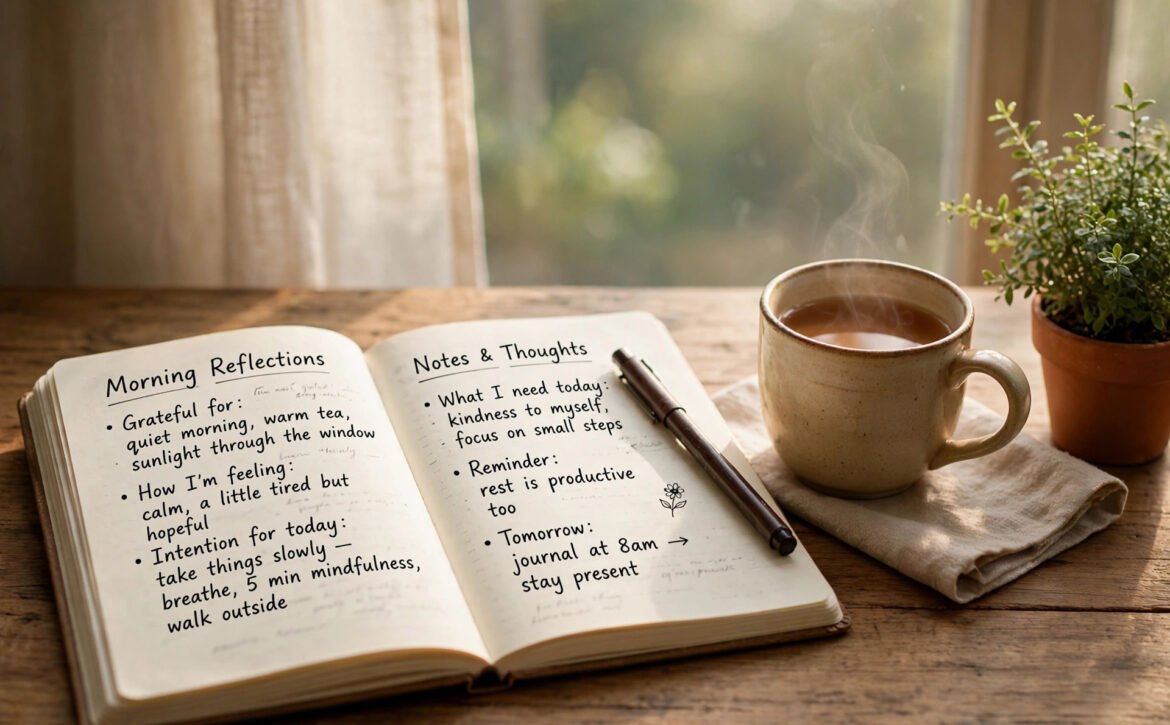
Category: Mental Wellness

Journaling for Mental Health: A Beginner’s Guide

You don’t need perfect handwriting, profound insights, or even complete sentences to benefit from writing. Journaling for mental health is simply the practice of putting your thoughts and feelings into words — on paper or screen — and decades of research suggest this simple habit can reduce stress, ease anxiety, and help you understand yourself better. Best of all, it costs nothing and takes as little as ten minutes a day.

If you have ever thought “I wouldn’t know what to write” or “I’m not a writer,” this beginner’s guide is for you. Below you will learn what journaling actually does for your mind, seven easy methods to try, a simple daily routine to get started, and the mistakes that trip up most beginners.

What Is Journaling for Mental Health?

Therapeutic journaling is writing with the intention of processing emotions rather than recording events. Unlike a diary that lists what happened today (“went to work, ate lunch”), mental health journaling explores how you felt about what happened and why. It is a private, judgment-free space where you can be completely honest — no audience, no performance, no filter.

The practice became widely studied in the 1980s when psychologist James Pennebaker found that people who wrote about emotional experiences for just 15–20 minutes a few times a week showed measurable improvements in well-being. Since then, hundreds of studies on “expressive writing” have confirmed that translating feelings into language helps the brain process them — turning vague emotional static into something you can actually work with.

The Benefits of Journaling for Your Mind

Why does something so simple work so well? Researchers point to several mechanisms:

  • It externalizes the mental loop. Worries lose power once they leave your head. Writing forces your brain to organize scattered thoughts into linear language, which naturally calms rumination.
  • It creates emotional distance. Seeing your fears written down lets you examine them like an observer instead of drowning in them — similar to the “name it to tame it” principle.
  • It reveals patterns. After a few weeks, you start noticing triggers: the Sunday-night dread, the conversation that always leaves you tense. Awareness is the first step to change.
  • It tracks progress. On hard days, flipping back through old entries reminds you how far you have come — something memory alone rarely does fairly.
  • It supports other healthy habits. Many people find journaling deepens practices like mindfulness and gratitude, which is why it pairs so well with our mindfulness meditation guide.

The National Institute of Mental Health includes writing and self-reflection among healthy coping strategies for managing stress and emotions (NIMH: Caring for Your Mental Health). Journaling is not therapy, but it is a genuinely useful complement to a healthy mental lifestyle.

7 Simple Journaling Methods for Beginners

There is no single “right” way to journal. Try a few of these and keep what fits.

1. Expressive Writing

The classic method from the research: write continuously for 15–20 minutes about whatever is weighing on you emotionally. Don’t worry about grammar or structure — let it pour out. If you run out of things to say, repeat your last sentence until new thoughts come. Many people do this 3–4 times a week during stressful periods and report feeling noticeably lighter afterward.

2. Gratitude Journaling

Each day, write down three specific things you are grateful for — and why. “My morning coffee” is fine; “My morning coffee, because those ten quiet minutes before the kids wake up make me feel human” is better. Specificity trains your brain to notice good things, which gradually shifts your default attention away from threats and irritations.

3. The Daily Brain Dump

Set a timer for five minutes and write every thought in your head, in any order, with zero editing. This is less about insight and more about clearing mental RAM. It is especially powerful before bed or before deep work — and it is one of the fastest ways to quiet a racing mind. If overthinking is your main struggle, combine this with the techniques in our guide on how to stop overthinking.

4. Prompt-Based Journaling

Blank pages intimidate beginners, so prompts help. Keep a list handy and pick one:

  • What emotion am I feeling right now, and where do I feel it in my body?
  • What is one thing I would do today if I weren’t afraid?
  • What did I handle well this week?
  • What would I tell a friend going through what I’m going through?
  • What do I need more of — and less of — in my life right now?

5. Morning Pages

Made famous by Julia Cameron’s The Artist’s Way, morning pages are three longhand pages written first thing in the morning, before your inner critic wakes up. Write whatever comes — complaints, dreams, grocery lists. The point is clearing the mental windshield before the day begins. Even one page counts if three feels like too much.

6. Mood and Trigger Tracking

End each day with three quick lines: your overall mood (1–10), the day’s high point, and the day’s low point. Over a month, patterns emerge with striking clarity — you might discover your mood dips every Thursday (late meetings?) or lifts on days you walk outside. This data becomes genuinely useful for making life adjustments.

7. The Unsent Letter

Write a letter to someone — living or not — saying everything you never said. You will never send it; that is the point. Unsent letters are a safe way to process grief, anger, forgiveness, or gratitude without real-world consequences. Many therapists recommend this exercise, and clients often describe a profound sense of release afterward.

How to Start: A Simple 10-Minute Daily Routine

Forget the fantasy of the perfect leather journal and fountain pen. Here is a routine that actually sticks:

  1. Pick your tool (2 minutes of decision, max). A cheap notebook, a notes app, a Google Doc — whatever you will actually open. Fancy supplies are optional.
  2. Anchor it to an existing habit. Journal right after your morning coffee or right before bed. Habits stick best when stacked onto routines you already have.
  3. Set a tiny target. Commit to five minutes or half a page — not an hour. You can always write more; the goal is showing up.
  4. Start with a prompt. Use one from the list above or simply finish this sentence: “Right now I feel…”
  5. End with one kind sentence to yourself. Close every entry the way you would end a conversation with a friend — with warmth, not criticism.

Protect your privacy so you can be honest: use a locked app, a password-protected document, or a notebook you keep somewhere private. You will write more freely when you trust no one will read it.

Common Mistakes Beginners Make

  • Waiting for the “right” mood. You don’t journal because you feel calm; you journal to become calm. Write especially on the messy days.
  • Editing yourself. If you are choosing elegant words, you are performing, not processing. Ugly, honest writing helps more than pretty, guarded writing.
  • Forcing positivity. Toxic positivity in a journal defeats the purpose. If you are angry, write angry. You can look for silver linings later — or not.
  • Quitting after three days. The benefits compound over weeks, not days. Give any method at least two to three weeks before judging it.
  • Treating it as a chore. If a method feels like homework, switch methods. Journaling should feel like exhaling, not like another obligation on your to-do list.

Frequently Asked Questions

How often should I journal for mental health benefits?

Research suggests 3–4 sessions per week of 15–20 minutes for expressive writing, but even a few minutes daily of gratitude or mood tracking shows benefits. Consistency matters far more than session length — a sustainable five-minute habit beats an ambitious hour-long one you abandon.

Is typing as effective as handwriting?

Both work. Some studies suggest handwriting slows you down in a useful way, encouraging deeper processing, while typing is faster and more practical for many people. The best method is the one you will actually do regularly — so choose based on your life, not the research.

What if writing about my feelings makes me feel worse?

This can happen, especially with expressive writing about difficult experiences — you might feel raw immediately afterward. Studies show this dip is usually temporary, with mood improving in the hours and days that follow. But if journaling consistently leaves you distressed, or you are working through trauma, consider doing it with the support of a mental health professional.

Do I need to keep my old journals?

Not necessarily. Keeping them lets you track patterns and progress over time, which many people find motivating. But if privacy worries make you censor yourself, give yourself full permission to shred or delete entries. An honest journal you destroy helps more than a guarded one you keep.

Can journaling replace therapy?

No. Journaling is a wonderful self-help tool and a great complement to therapy, but it is not a substitute for professional support — especially for depression, anxiety disorders, PTSD, or any crisis. Think of it as daily maintenance, not emergency care. If you are struggling, please reach out to a qualified professional.

Conclusion

Journaling for mental health works because it does something your mind cannot do alone: it turns swirling feelings into clear, examinable words. Whether you choose expressive writing, a three-line gratitude list, morning pages, or a simple nightly mood check, the mechanism is the same — honesty on paper creates clarity in the mind. Start tonight with just ten minutes and one prompt: “Right now I feel…” You might be surprised what comes out, and how much lighter you feel afterward. And if journaling becomes part of a broader calm-mind toolkit — alongside mindfulness, better sleep, and the stress-relief strategies in our guide to reducing stress and anxiety naturally — you will have built yourself a genuinely resilient daily practice.

Disclaimer: This article is for general informational purposes only and is not a substitute for professional medical or mental health advice. If you are struggling, please consult a qualified professional.


Read More

How to Stop Overthinking: 9 Practical Techniques That Work

Does your mind ever feel like a browser with 47 tabs open — every one of them replaying an awkward conversation or rehearsing a disaster that hasn’t happened? If so, you are not alone, and learning how to stop overthinking may be one of the most valuable skills you can build for your mental health. Overthinking rarely solves problems; instead, it drains your energy, steals your sleep, and makes small worries feel enormous.

The good news is that overthinking is a habit, not a life sentence. Psychologists have studied repetitive thought for decades and found practical, learnable techniques that genuinely help people break the cycle. In this guide, you will learn exactly what overthinking is, why your brain does it, and 9 research-informed techniques you can start using today to calm a racing mind.

What Is Overthinking, Really?

Overthinking means spending more time thinking about something than is useful. Instead of moving toward a solution, your thoughts loop — going over the same ground again and again without making progress. Researchers generally describe two forms of it.

Rumination: Replaying the Past

Rumination is chewing on past events: the thing you said in the meeting, the argument you lost, the mistake from three years ago. It usually comes with self-criticism and questions that have no answer, like “Why did I do that?” or “What’s wrong with me?” Rumination keeps your stress response switched on long after the event is over.

Worry: Rehearsing the Future

Worry is rumination’s forward-looking twin. It is the mental rehearsal of everything that could go wrong: the presentation next week, the test result, the economy. Worry feels productive — like you are preparing — but studies show it rarely leads to better preparation. It mostly leads to exhaustion.

Most overthinkers do both. The first step to learning how to stop overthinking is noticing which pattern you fall into, because different techniques work better for different patterns.

Why Can’t I Stop Overthinking?

Your brain is not broken. Overthinking is, in a strange way, your mind trying to protect you. Understanding the “why” makes the techniques below much more effective.

  • Your brain hates uncertainty. When the future is unclear, your mind fills the gap with simulations — most of them negative, because your brain evolved to prioritize threats.
  • Perfectionism fuels the loop. If you believe there is one “right” decision, every choice becomes a high-stakes exam you can fail.
  • Stress narrows your thinking. When you are tired, hungry, or overwhelmed, the brain’s threat system takes over and rational perspective shrinks.
  • Modern life never pauses. Constant news, notifications, and comparison on social media give your mind an endless supply of material to chew on.

Knowing this matters because overthinking is not a character flaw — it is a misfiring protection system. And like any habit, it can be retrained.

9 Practical Techniques to Stop Overthinking

These techniques are drawn from cognitive-behavioral therapy (CBT), mindfulness research, and clinical psychology. Try them one at a time; you don’t need all nine to feel a difference.

1. Name It to Tame It

When you catch yourself spiraling, pause and label what is happening: “I am ruminating right now” or “This is worry, not problem-solving.” Neuroscientists call this affect labeling, and brain-imaging studies show that simply naming an emotion reduces activity in the brain’s alarm center, the amygdala. A label creates a small distance between you and the thought — you become the observer, not the thought itself.

2. Give Worry an Appointment

Instead of fighting worried thoughts all day, schedule a daily 15-minute “worry window” — say, 5:30 PM. When a worry pops up outside that time, jot it on a note and tell yourself, “I’ll deal with you at 5:30.” Most people find that by the time the appointment arrives, half the worries have dissolved on their own, and the rest feel smaller and more manageable. This technique, called stimulus control, is a classic CBT strategy.

3. Do a 5-Minute Brain Dump

Grab a notebook or open a notes app and write every thought in your head as fast as you can — no editing, no organizing, no complete sentences required. The goal is to move the loop from your mind onto paper, where it loses its power. Once it is written down, your brain can stop rehearsing it, because the information is safely stored. Many people combine this with journaling for mental health as a daily calming ritual.

4. Put the Thought on Trial

Overthinking thrives on unexamined assumptions. Take your loudest worry and interrogate it like a detective:

  • What is the actual evidence this will happen?
  • What is the evidence against it?
  • What would I say to a friend who had this thought?
  • What is the most realistic outcome — not the best, not the worst?

You will usually find the catastrophic version is the least likely one. This cognitive-reframing exercise is one of the most widely supported techniques in anxiety research, and the National Institute of Mental Health notes that challenging unhelpful thought patterns is a core part of effective stress management (NIMH: Caring for Your Mental Health).

5. Ground Yourself With the 5-4-3-2-1 Technique

Overthinking lives in the past and future; grounding pulls you into the present. Slowly notice: 5 things you can see, 4 things you can touch, 3 things you can hear, 2 things you can smell, and 1 thing you can taste. Engage each sense fully. By the end, your nervous system has received a clear signal: right here, right now, you are safe. This is a favorite grounding tool used in mindfulness practice, and it pairs beautifully with the beginner exercises in our mindfulness meditation guide.

6. Move Your Body

You cannot think your way out of a stress loop while sitting still — sometimes you have to move through it. A brisk 20-minute walk, a workout, or even stretching changes your brain chemistry: it burns off stress hormones like cortisol and releases endorphins. Many overthinkers report that their clearest thinking happens after exercise, not before it. If your mind is racing at night, note that late-day movement can also improve sleep, which is closely tied to calmer thinking — see our guide on how to fix your sleep schedule.

7. Limit the Inputs

You cannot stop overthinking if you keep feeding your brain alarming material. Audit your inputs for one week:

  • Turn off non-essential news alerts and set specific times to check the news.
  • Mute or unfollow social media accounts that trigger comparison or outrage.
  • Notice which conversations leave you spiraling, and set gentle boundaries around them.

This is not avoidance — it is hygiene. A calmer information diet gives your mind less raw material to overthink about.

8. Set a Decision Deadline

Perfectionists overthink decisions because every option stays open forever. Break the stalemate with a deadline: “I will decide by Friday at noon.” Then use the 80/20 rule — gather enough information to be 80% confident, and accept that the last 20% of certainty is never worth the stress. For most everyday decisions, a “good enough” choice made calmly beats a “perfect” choice made after three sleepless nights. Remember: most decisions are reversible, and even the best decision-makers are wrong sometimes.

9. Build a Daily Mindfulness Practice

Mindfulness trains the exact mental muscle overthinking weakens: the ability to notice a thought without getting pulled into it. You do not need an hour of meditation. Start with five minutes a day of focused breathing — inhale for four counts, exhale for six — and gently return your attention each time it wanders. Research reviewed by the National Center for Complementary and Integrative Health suggests mindfulness practices can help reduce anxiety and rumination (NCCIH: Meditation and Mindfulness). Over weeks, you will find the gap between “having a thought” and “believing a thought” grows wider — and that gap is freedom.

When Overthinking Might Be Something More

Occasional overthinking is normal. But if racing thoughts are constant, interfere with work or relationships, or come with persistent low mood, panic, or an inability to sleep, it may be worth speaking with a mental health professional. Conditions like generalized anxiety disorder and depression often involve uncontrollable repetitive thought — and both are highly treatable. Reaching out is a sign of strength, not failure. If you are looking for calming strategies in the meantime, our article on ways to reduce stress and anxiety naturally may help.

Frequently Asked Questions

Is overthinking a mental illness?

Overthinking itself is not a diagnosis — it is a common thinking pattern that almost everyone experiences. However, persistent, uncontrollable overthinking can be a symptom of anxiety disorders or depression. If it disrupts your daily life, consider talking to a mental health professional for personalized guidance.

How long does it take to stop overthinking?

There is no fixed timeline, but most people notice improvement within a few weeks of consistently practicing techniques like worry windows, cognitive reframing, and mindfulness. Think of it like physical training: small daily reps build the mental muscle over time.

Can overthinking cause physical symptoms?

Yes. Chronic overthinking keeps your stress response activated, which can contribute to headaches, muscle tension, digestive issues, fatigue, and sleep problems. This mind-body connection is one reason calming techniques that address both — like exercise and mindfulness — tend to work well.

What is the fastest way to stop overthinking in the moment?

The 5-4-3-2-1 grounding technique or a quick brain dump usually works fastest, because both interrupt the thought loop immediately. For a racing mind at night, combining a brain dump with slow breathing is especially effective.

Should I try to stop all negative thoughts?

No — and trying to will backfire. The goal is not an empty mind but a healthier relationship with your thoughts: noticing them, evaluating them fairly, and choosing which ones deserve your attention. Some worry is useful; it is the endless, unproductive looping that you want to reduce.

Conclusion

Learning how to stop overthinking is not about silencing your mind — it is about changing your relationship with your thoughts. Start small: pick one technique from this list, like the worry window or the 5-minute brain dump, and practice it daily for two weeks. Notice which of your loops are rumination and which are worry, feed your brain calmer inputs, move your body, and give yourself the same compassion you would offer a friend. Your mind is a powerful tool; with practice, you can make it work for you instead of against you. And if the loop ever feels too heavy to break alone, professional support is always a strong and healthy option.

Disclaimer: This article is for general informational purposes only and is not a substitute for professional medical or mental health advice. If you are struggling, please consult a qualified professional.
Read More

Mindfulness Meditation for Beginners: A 5-Minute Daily Practice

Mindfulness meditation for beginners does not require silence, incense, or an empty mind — just five minutes and a willingness to notice the present moment. Mindfulness simply means paying attention to what is happening right now — your breath, your body, your surroundings — without judging it. Research suggests even brief daily practice can reduce stress, improve focus, and support emotional balance. This guide gives you a complete 5-minute daily practice you can start today, plus the beginner mistakes to avoid.

What Is Mindfulness Meditation?

At its core, mindfulness meditation is training your attention. You choose one anchor — usually the breath — and gently return your focus to it whenever your mind wanders (and it will wander; that is the exercise, not a failure). Unlike relaxation techniques that try to force calm, mindfulness builds the skill of noticing thoughts and feelings without being carried away by them.

The National Center for Complementary and Integrative Health notes that mindfulness meditation programs show modest but real benefits for anxiety, depression, and stress in research studies. It is not a cure or a replacement for treatment, but it is a low-cost, low-risk habit with genuine upside — and one of the few wellness practices supported by a growing body of peer-reviewed research.

Benefits of a Short Daily Practice

  • Less reactivity to stress: regular practice is linked to calmer responses to everyday pressures.
  • Better focus: attention is like a muscle — returning it to the breath repeatedly strengthens concentration.
  • Improved emotional awareness: you start noticing mood shifts earlier, before they spiral.
  • Better sleep: a calmer evening mind falls asleep faster — mindfulness pairs beautifully with the sleep habits in our guide on why sleep is important.
  • Support for anxiety management: combined with other strategies in our guide on how to reduce stress and anxiety naturally, it forms a strong daily toolkit.

Your 5-Minute Daily Practice (Step by Step)

Do this once a day — morning works well, but any consistent time is fine. Sit comfortably; you do not need to twist into a lotus position. A chair is perfect.

  1. Settle in (30 seconds). Sit upright but relaxed, feet flat on the floor, hands resting on your lap. Set a gentle timer for 5 minutes. Close your eyes or soften your gaze downward.
  2. Take three conscious breaths (30 seconds). Breathe in slowly through your nose, feeling your belly rise; exhale slowly through your mouth. Let your shoulders drop.
  3. Find your anchor (2 minutes). Return to natural breathing through your nose. Notice the sensation of air at your nostrils, or your belly rising and falling. That is your anchor.
  4. Notice wandering — and return (2 minutes). Thoughts will appear: plans, worries, itches, sounds. Each time you notice you have drifted, silently label it “thinking” and gently guide attention back to the breath. Every return is one rep of the exercise.
  5. Close with awareness (30 seconds). Widen your attention: notice sounds around you, the feeling of your body in the chair, then slowly open your eyes. Take a moment before jumping into your day.

Common Beginner Mistakes to Avoid

  • Trying to “empty your mind.” Impossible — and not the goal. The goal is noticing, not blankness.
  • Judging your sessions. A “bad” session full of wandering is still training. There are no failed sits.
  • Starting with 20 minutes. Long sessions invite frustration and quitting. Five consistent minutes beats twenty occasional ones.
  • Only meditating when stressed. Practice on calm days builds the skill you will need on hard days.
  • Expecting instant transformation. Benefits typically build over weeks of regular practice, not one sitting.

Bringing Mindfulness Into Everyday Moments

Formal sitting practice is only half the story. Informal mindfulness — bringing full attention to ordinary activities — extends the benefits through your whole day:

  • Mindful eating: for the first few bites of a meal, notice colors, textures, flavors, and chewing. You will enjoy food more and often feel satisfied sooner.
  • Mindful walking: feel your feet touching the ground, the swing of your arms, the air on your skin. Leave the earbuds out occasionally.
  • Mindful listening: in your next conversation, listen fully without planning your reply. People notice — and relationships improve.
  • One-breath resets: before opening email, starting your car, or entering a meeting, take one slow conscious breath. These micro-pauses interrupt autopilot dozens of times a day.

These tiny moments train the same attention muscle as sitting practice, and they require zero extra time — just intention.

Tips to Build a Lasting Habit

  • Anchor it to an existing routine — right after brushing your teeth or before your morning tea.
  • Same time, same place removes daily decision-making.
  • Track your streak — a simple calendar checkmark is surprisingly motivating.
  • Use guided sessions if helpful — free apps and videos can coach your first weeks, then try silent practice.
  • Be kind to yourself on missed days — just begin again tomorrow. Consistency over months matters more than any single week.

Frequently Asked Questions

Do I need to sit cross-legged on the floor?

No. Any stable, comfortable, upright posture works — a chair, a couch, even a park bench. The point is alertness without tension, not a particular pose. Lying down is fine too, though beginners often fall asleep that way.

What if I cannot stop thinking?

You are not supposed to stop thinking. Thinking is what minds do. Mindfulness is the practice of noticing thoughts and returning to the breath — the wandering is the workout. If your mind wanders 100 times and you return 100 times, that was an excellent session.

Is 5 minutes really enough to see benefits?

Five minutes is enough to build the habit, which is the real battle. Research on mindfulness typically studies 10–30 minute practices, but beginners who start with 5 sustainable minutes and gradually extend tend to stick with it far longer — and long-term consistency is what produces results. Start at 5; expand when it feels easy.

Can mindfulness replace therapy or medication for anxiety?

No — it is a complement, not a replacement. Mindfulness can support anxiety management alongside other strategies, but persistent anxiety, depression, or panic deserve professional care. The NIMH emphasizes that anxiety conditions are highly treatable — reaching out is the strongest move you can make.

When is the best time of day to meditate?

The best time is whenever you will actually do it daily. Mornings set a calm tone for the day; evenings help transition toward sleep (pair it with the wind-down tips in our guide to fixing your sleep schedule). Experiment for a week and keep what sticks.

Conclusion

Mindfulness meditation for beginners boils down to this: sit comfortably, follow your breath for five minutes, and gently return whenever your mind wanders. No special equipment, no empty mind required. Practiced daily, those five minutes quietly build focus, calm, and emotional steadiness — and the informal moments you sprinkle through your day multiply the effect.

Your next step: set a timer for 5 minutes right now and do your first session today — not tomorrow. Then visit our Mental Wellness section for more practices that support a calmer mind.

General health information only — not medical advice. Talk to a qualified professional about personal health decisions. See our Disclaimer.

Read More

10 Simple Ways to Reduce Stress and Anxiety Naturally

Learning how to reduce stress and anxiety naturally is one of the most valuable skills for modern life. Occasional stress is normal — it is your body’s built-in alarm system. But when stress becomes constant, it disrupts sleep, digestion, immunity, focus, and even heart health. The encouraging news: research supports many simple, drug-free strategies that genuinely calm your nervous system. This guide shares 10 practical, natural ways to lower stress and anxiety, plus clear guidance on when professional help is the right next step.

Understanding Stress vs. Anxiety

Stress is usually a response to an external pressure — a deadline, an argument, a bill. Anxiety is more like the alarm ringing without a clear threat: persistent worry, restlessness, or dread. The two feed each other, and the same calming strategies help both. According to the National Institute of Mental Health, anxiety disorders are among the most common mental health conditions — and they are highly treatable, which is why reaching out for help is a sign of strength, not weakness.

10 Simple Ways to Reduce Stress and Anxiety Naturally

1. Practice Slow, Deep Breathing

Your breath is a remote control for your nervous system. Slow exhaling activates the parasympathetic (“rest and digest”) response. Try box breathing: inhale for 4 counts, hold for 4, exhale for 4, hold for 4 — repeat for 2–3 minutes. It works anywhere: before a meeting, in traffic, or in bed.

2. Move Your Body Daily

Exercise is one of the most evidence-backed natural anxiety reducers. It burns off stress hormones, releases endorphins, and improves sleep — which further lowers anxiety. You do not need intense workouts: a brisk 20–30 minute walk counts. Building toward 10,000 steps a day is a gentle, sustainable target, and the WHO confirms regular activity benefits mental health too.

3. Protect Your Sleep

Poor sleep and anxiety form a vicious circle: anxiety ruins sleep, and short sleep raises next-day anxiety. Prioritizing 7–9 hours with a consistent schedule is foundational. Our guide on why sleep is important explains the science and gives practical tips for better rest.

4. Cut Back on Caffeine and Alcohol

Caffeine stimulates the same fight-or-flight system that anxiety hijacks — for sensitive people, that afternoon coffee can feel like panic. Alcohol may relax you initially but disrupts sleep and rebounds into next-day anxiety. Try two weeks with less of both and notice the difference.

5. Try Mindfulness or Meditation

Mindfulness trains you to observe anxious thoughts without being swept away by them. Research reviewed by the NCCIH suggests mindfulness meditation can modestly reduce anxiety symptoms. Start tiny — our mindfulness meditation guide for beginners walks you through a simple 5-minute daily practice.

6. Spend Time in Nature

Even 20 minutes in a park, garden, or green street measurably lowers cortisol in studies. Natural settings give your threat-scanning brain a break. No wilderness required — a tree-lined walk or sitting by water counts.

7. Write It Down (Journaling)

Putting worries on paper externalizes them — your brain stops looping on thoughts it trusts are “saved.” Try a 5-minute evening brain dump, or write down three things you are grateful for. Both practices are linked to lower perceived stress.

8. Connect With People

Humans regulate each other’s nervous systems. A real conversation with a friend, family member, or neighbor — even a short one — can defuse a stressful day faster than scrolling. If you are isolated, consider a class, club, volunteering, or a support community.

9. Limit News and Doomscrolling

Constant alarming headlines keep your threat system switched on. Set boundaries: check news once or twice a day at set times, keep your phone out of the bedroom, and notice how your body feels after 30 minutes of scrolling versus 30 minutes offline.

10. Build a Calming Daily Routine

Anxiety thrives on chaos and unpredictability. Anchor your day with a few calming rituals: a morning walk, regular mealtimes, a wind-down hour before bed, a weekly hobby you enjoy. Routine tells your nervous system the world is predictable and safe.

Build a Simple Anti-Stress Daily Routine

Individual techniques work best when woven into your day. Here is a sample routine you can adapt:

  • Morning: 5 minutes of slow breathing or stretching before checking your phone; a short walk in daylight.
  • Midday: a real lunch break away from screens; a 10-minute walk after eating.
  • Evening: write tomorrow’s top three tasks to empty your mind; dim lights an hour before bed; a calming wind-down such as reading or gentle music.
  • Weekly: one longer restorative activity — a nature walk, a hobby session, or quality time with someone you enjoy.

You do not need to adopt all of these at once. Add one anchor at a time; within a month you will have a genuinely calmer daily rhythm.

When to Seek Professional Help

Natural strategies help many people with everyday stress and mild anxiety — but they are not a substitute for professional care when you need it. Consider talking to a doctor, counselor, or therapist if anxiety persists for weeks, interferes with work, relationships, or sleep, causes panic attacks, or leads you to avoid important parts of life. Effective treatments exist, including therapy and, when appropriate, medication. If you ever feel you might harm yourself, contact a local crisis helpline or emergency services immediately.

Frequently Asked Questions

What is the fastest way to calm anxiety in the moment?

Slow breathing is the quickest evidence-backed tool: long, slow exhales signal safety to your nervous system within a couple of minutes. Splashing cold water on your face or stepping outside for fresh air can also interrupt an acute spike.

Can anxiety be reduced without medication?

For mild to moderate everyday anxiety, lifestyle strategies — exercise, sleep, breathing, mindfulness, limiting caffeine/alcohol — help many people significantly. For persistent or severe anxiety, professional treatment (therapy, sometimes medication) is the most effective path, and combining it with these habits works best.

Does exercise really help anxiety?

Yes. Regular aerobic exercise is consistently linked to lower anxiety symptoms in research — effects comparable to some other interventions for mild anxiety. Both single sessions (one walk can calm you today) and long-term routines help.

Why is my anxiety worse at night?

At night, distractions fade and the mind replays the day; fatigue also lowers emotional resilience. A wind-down routine — dim lights, no news, journaling tomorrow’s tasks, slow breathing — gives your brain an “off switch.” Persistent nighttime anxiety that ruins sleep deserves a conversation with your doctor.

Are herbal supplements good for anxiety?

Evidence for most “calming” supplements is limited or mixed, and natural does not automatically mean safe — some interact with medications. Be skeptical of miracle claims. If you are curious about any supplement, discuss it with your doctor or pharmacist first.

Conclusion

Reducing stress and anxiety naturally comes down to calming your nervous system daily: breathe slowly, move regularly, sleep well, ease off stimulants, spend time in nature and with people, and give your mind quiet moments. Small, consistent habits compound into genuine resilience.

Your next step: pick one strategy from this list and practice it today — even two minutes of slow breathing counts. Then explore our Mental Wellness section for more guides on building a calmer mind.

General health information only — not medical advice. Talk to a qualified professional about personal health decisions. See our Disclaimer.

Read More