09 Oct
Dumbbell Workout for Beginners: Full-Body Routine in 30 Minutes
If you want to get stronger, build lean muscle, and improve your fitness without spending hours in the gym, a dumbbell workout for beginners is one of the smartest places to start. With just one pair of dumbbells, you can train your legs, glutes, chest, back, shoulders, and arms in a single 30-minute session — at home, in a garage, or at the gym.
This guide gives you a complete, beginner-friendly routine you can follow today. You will learn how to choose the right weight, how to perform each exercise with safe form, how to structure the 30 minutes so you finish on time, and how to progress week by week. No complicated machines, no confusing programs, and no jumping or high-impact moves.
If you are completely new to strength training, you may also find our guide to strength training for beginners at home helpful for building confidence with bodyweight basics first.
Why a Dumbbell Workout for Beginners Works So Well
Dumbbells are ideal for beginners because they are simple, versatile, and forgiving. Unlike a barbell, each hand works independently, which helps you notice and fix strength differences between your left and right sides. Unlike machines, dumbbells require your stabilizing muscles to work, which improves balance, coordination, and joint control in ways that carry over to daily life — carrying groceries, lifting children, climbing stairs, and preventing falls.
Key benefits you can expect
Builds full-body strength: A well-designed dumbbell routine hits all the major muscle groups in one session, so you do not need separate leg days, arm days, and back days when you are starting out.
Supports healthy weight management: Muscle tissue is metabolically active. As you build strength, you burn more calories at rest, and the workout itself elevates your heart rate enough to support cardiovascular fitness.
Protects joints and bones: Progressive resistance training helps maintain bone density and strengthens the muscles and connective tissues that support your knees, hips, shoulders, and spine.
Fits a busy schedule: Thirty minutes, two to three times per week, is enough for a beginner to make measurable progress. The Centers for Disease Control and Prevention recommends that adults aim for muscle-strengthening activities on two or more days per week, in addition to regular aerobic activity (CDC Physical Activity Basics).
What You Need to Get Started
You do not need a full rack of weights to begin. Here is the simple setup that works for most beginners:
One pair of light dumbbells: 5 to 10 pounds (2 to 4.5 kg) for upper-body exercises if you are brand new to training.
One pair of moderate dumbbells: 10 to 20 pounds (4.5 to 9 kg) for lower-body exercises like squats and deadlifts, where your legs are naturally stronger. Adjustable dumbbells are a space-saving alternative if you plan to train at home long-term.
A flat, non-slip surface: An exercise mat on a hard floor works well. Avoid training on thick carpet, which can make your footing unstable.
Comfortable clothing and supportive shoes: Flat-soled training shoes or bare feet (on a mat) give you better stability for squats and deadlifts than thick running shoes.
A timer: Your phone timer is perfect for keeping the 30-minute structure on track.
How to Choose the Right Dumbbell Weight
The right weight is the one that lets you complete the last two repetitions of a set with effort, while still keeping perfect form. If you can breeze through every rep without slowing down, the weight is too light. If your form breaks down — your knees cave in, your back rounds, or you have to swing the weights — it is too heavy.
Use this simple test: pick up a weight and perform 10 slow repetitions of a dumbbell row. If reps 8, 9, and 10 feel challenging but controlled, that is a good starting weight for upper-body pulling exercises. For goblet squats and deadlifts, most beginners can safely start with a weight that is 5 to 10 pounds heavier than their upper-body weight, because the legs and glutes are larger, stronger muscle groups.
When in doubt, start lighter. You can always add weight next week. Starting too heavy is the fastest way to develop sore joints, poor habits, and an injury that sets you back a month.
Warm-Up: 5 Minutes to Prepare Your Body
Never start lifting with cold muscles. A short warm-up raises your body temperature, lubricates your joints, and rehearses the movement patterns you are about to load. Spend about 30 seconds on each of these:
March or jog in place, arm circles forward and backward, bodyweight squats, hip hinges with no weight, alternating reverse lunges, band-free shoulder rolls and chest openers, cat-cow spinal mobility on all fours, and a final set of slow bodyweight good mornings.
By the end of five minutes you should feel warm, slightly breathless, and ready to move. If a particular joint feels stiff, spend an extra 30 seconds gently moving it through a comfortable range of motion.
The 30-Minute Full-Body Dumbbell Workout for Beginners
Here is the core routine. You will perform six exercises in a circuit, rest briefly between exercises, and complete three full rounds. Each exercise is performed for 10 to 12 controlled repetitions. Rest 30 to 45 seconds between exercises and 90 seconds between rounds. At a steady pace, three rounds plus the warm-up fit comfortably into 30 minutes.
For a quick overview before you start: Round structure — Goblet Squat (10–12 reps), Dumbbell Romanian Deadlift (10–12 reps), Dumbbell Floor Press (10–12 reps), One-Arm Dumbbell Row (10 reps per side), Standing Shoulder Press (8–10 reps), Glute Bridge with Dumbbell (12–15 reps). Rest, then repeat for three total rounds.
1. Goblet Squat — legs and glutes
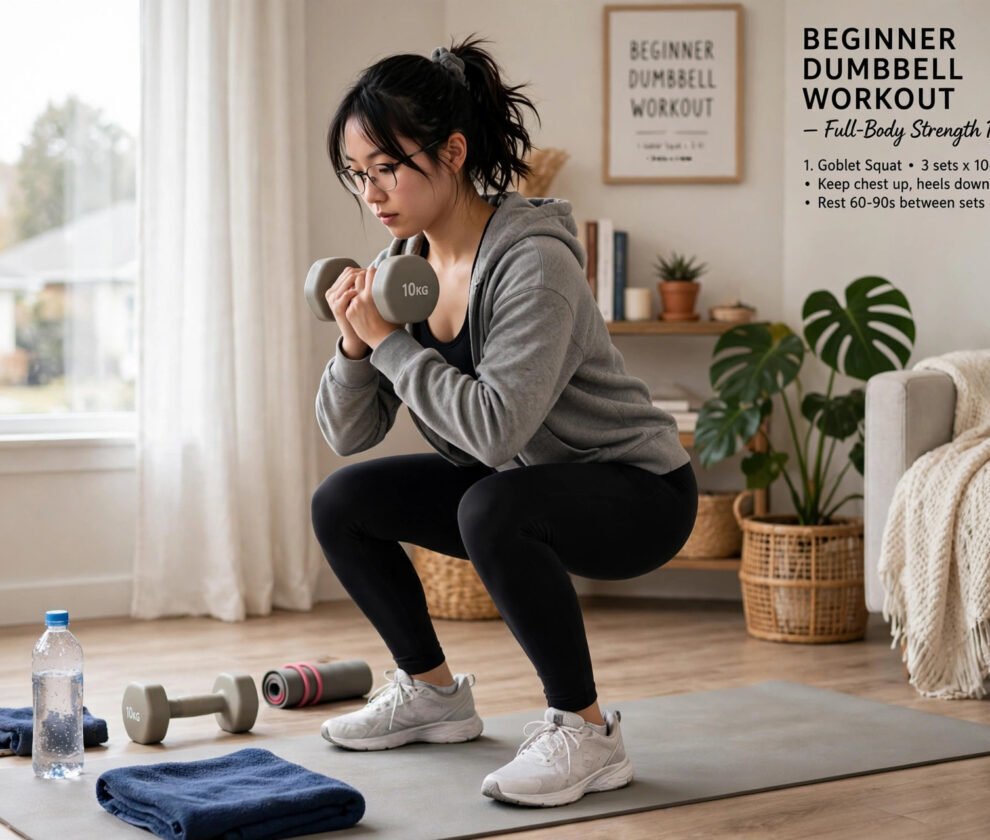
Hold one dumbbell vertically against your chest with both hands cupping the top end, elbows pointing down. Stand with your feet slightly wider than hip-width, toes turned out slightly. Keeping your chest tall, push your hips back and bend your knees to lower down until your thighs are roughly parallel to the floor, or as deep as you can go while keeping your heels down and your back straight. Drive through your whole foot to stand back up, squeezing your glutes at the top.
Beginner tip: Place a chair or bench behind you and lightly tap it with your glutes on each rep. This teaches proper depth and gives you confidence.
2. Dumbbell Romanian Deadlift — hamstrings, glutes, and back
Hold a dumbbell in each hand in front of your thighs, feet hip-width apart, knees soft. Hinge at your hips by pushing your glutes straight back, keeping your back flat and the dumbbells close to your legs. Lower until you feel a strong stretch in the back of your thighs, usually when the weights reach mid-shin. Drive your hips forward to return to standing, squeezing your glutes hard at the top. Do not round your lower back or turn this into a squat — the movement comes from the hips.
3. Dumbbell Floor Press — chest, shoulders, and triceps
Lie on your back on the floor or a mat, knees bent, feet flat. Hold a dumbbell in each hand above your chest, palms facing your feet. Lower the weights slowly until your upper arms lightly touch the floor, elbows at about a 45-degree angle from your body. Press the dumbbells back up until your arms are straight, without letting the weights clang together. The floor limits your range of motion slightly, which makes this exercise especially shoulder-friendly for beginners compared with a bench press.
4. One-Arm Dumbbell Row — back and biceps
Place your left knee and left hand on a bench, chair, or sturdy couch edge, with your right foot on the floor. Hold a dumbbell in your right hand, arm hanging straight down, back flat and parallel to the floor. Pull the dumbbell up toward your hip, driving your elbow toward the ceiling and squeezing your shoulder blade. Lower slowly with control. Complete all reps on one side, then switch. This unilateral exercise is excellent for fixing left-right strength imbalances.
5. Standing Dumbbell Shoulder Press — shoulders and core
Stand tall with feet hip-width apart, holding a dumbbell in each hand at shoulder height, palms facing forward. Brace your core as if you are about to be punched in the stomach, squeeze your glutes, and press the weights straight overhead until your arms are fully extended. Lower slowly to shoulder height. If you feel your lower back arching, the weight is too heavy or you need to press one arm at a time while the other stays at your shoulder for extra stability. On days when you want a cardio-focused finisher instead, our beginner HIIT workout pairs well with this strength routine on alternate days.
6. Dumbbell Glute Bridge — glutes and core stability
Lie on your back, knees bent, feet flat and close to your glutes. Rest one dumbbell horizontally across your hips, holding it steady with both hands. Drive through your heels to lift your hips until your body forms a straight line from your shoulders to your knees. Squeeze your glutes hard for one full second at the top, then lower slowly. This exercise is foundational for hip health, lower-back support, and building the posterior-chain strength that makes deadlifts and daily lifting safer.
How to Fit It All Into Exactly 30 Minutes
Minutes 0–5: Warm-up as described above. Minutes 5–27: Three rounds of the six-exercise circuit, resting 30–45 seconds between exercises and 90 seconds between rounds. Minutes 27–30: Cool-down (see below). If you finish a round faster than expected, slow your repetitions down rather than adding extra exercises — controlled tempo builds more strength and keeps joints happy. A good tempo is two seconds to lower, one second to pause, and one to two seconds to lift.
If three full rounds feel too difficult in week one, complete two rounds with perfect form and add the third round in week two or three. Consistency with good form always beats exhaustion with sloppy form.
Cool-Down and Recovery
Spend the final three minutes bringing your heart rate down and lengthening the muscles you just worked. Hold each stretch for 20 to 30 seconds per side: standing quadriceps stretch, standing hamstring stretch with one heel on the floor, chest doorway stretch, cross-body shoulder stretch, and a gentle standing figure-four glute stretch. Breathe slowly and deeply throughout.
Recovery matters as much as the workout itself. Beginners often feel muscle soreness 24 to 48 hours after their first session — this is normal and is called delayed onset muscle soreness. Light walking, gentle stretching, hydration, protein-rich meals, and good sleep all help you recover faster. In fact, low-intensity movement on rest days, such as the walking routine described in our guide to walking 10,000 steps a day, is one of the best active-recovery tools you have.
Your Weekly Schedule for the First Four Weeks
For the first month, perform this dumbbell workout for beginners two to three times per week on non-consecutive days — for example, Monday, Wednesday, and Friday. Your muscles need at least 48 hours to recover and adapt between sessions that train the same muscle groups.
Weeks 1–2: Two rounds per session, light weights, focus entirely on learning form. Weeks 3–4: Three rounds per session, and when you can complete all reps of an exercise with good form for two sessions in a row, increase that exercise’s weight by 2 to 5 pounds. This gradual approach is called progressive overload, and it is the engine of all strength progress.
The National Institutes of Health’s MedlinePlus resource on exercise and physical fitness emphasizes starting slowly, using proper technique, and increasing intensity gradually to reduce injury risk (MedlinePlus: Exercise and Physical Fitness) — exactly the approach this plan follows.
Common Beginner Mistakes to Avoid
Rushing repetitions: Fast, jerky reps use momentum instead of muscle. Slow down, especially on the lowering phase.
Holding your breath: Exhale as you lift or press, inhale as you lower. Holding your breath through an entire set can spike your blood pressure uncomfortably.
Skipping the warm-up: Five minutes of preparation prevents weeks of dealing with a strain.
Training the same muscles every day: Muscles get stronger during recovery, not during the workout itself. Respect rest days.
Comparing your weights to others: The only comparison that matters is you versus you, last week. Track your weights and reps in a simple notebook or phone note.
Ignoring pain: Muscle effort and mild burning are normal. Sharp, sudden, or joint pain is not. Stop that exercise, check your form, and if pain persists, skip it and consult a qualified professional.
Frequently Asked Questions
Is a 30-minute dumbbell workout for beginners really enough to build muscle?
Yes, for a beginner it is. When you are new to resistance training, your muscles respond strongly to even modest stimulus. Six compound exercises, performed for three rounds with progressive weight increases over time, provide enough volume to build noticeable strength and muscle in the first several months — especially when combined with adequate protein and sleep.
How heavy should my first dumbbells be?
Most beginners do well starting with 5 to 10 pounds for upper-body exercises and 10 to 20 pounds for lower-body exercises. Choose a weight where the last two reps feel challenging but your form stays perfect. Starting lighter and progressing is always safer than starting too heavy.
How many times per week should I do this workout?
Two to three times per week on non-consecutive days is ideal for beginners. This frequency trains each muscle group often enough to progress, while leaving at least 48 hours for recovery between sessions.
Can I do this dumbbell workout at home without a bench?
Absolutely. Every exercise in this routine was selected to work without a bench. Use the floor for presses and glute bridges, and a sturdy chair, couch edge, or ottoman to support your knee and hand during one-arm rows.
What should I do on the days between workouts?
Stay active with light movement: walking, gentle yoga, stretching, or easy cycling. Active recovery improves circulation and reduces soreness without interfering with muscle repair. Avoid training the same muscles hard on consecutive days.
Conclusion
A dumbbell workout for beginners does not need to be complicated to be effective. One pair of dumbbells, six well-chosen exercises, 30 minutes, and two to three sessions per week are enough to build full-body strength, support a healthy metabolism, and create a fitness habit that lasts. Start with weights that let you master perfect form, progress gradually, and stay consistent — the results compound week after week.
Pick your first session day, set a timer for 30 minutes, and work through the warm-up and your first two rounds. That first completed workout is the hardest one. Every session after it gets a little easier, and you get a little stronger.
Disclaimer: This article is for general educational and informational purposes only and is not medical advice. It is not a substitute for guidance from a qualified healthcare provider, physical therapist, or certified fitness professional. Consult your doctor before beginning any new exercise program, especially if you have a heart condition, joint problems, high blood pressure, or any other medical concern. Stop exercising and seek medical attention if you experience chest pain, dizziness, or severe shortness of breath.